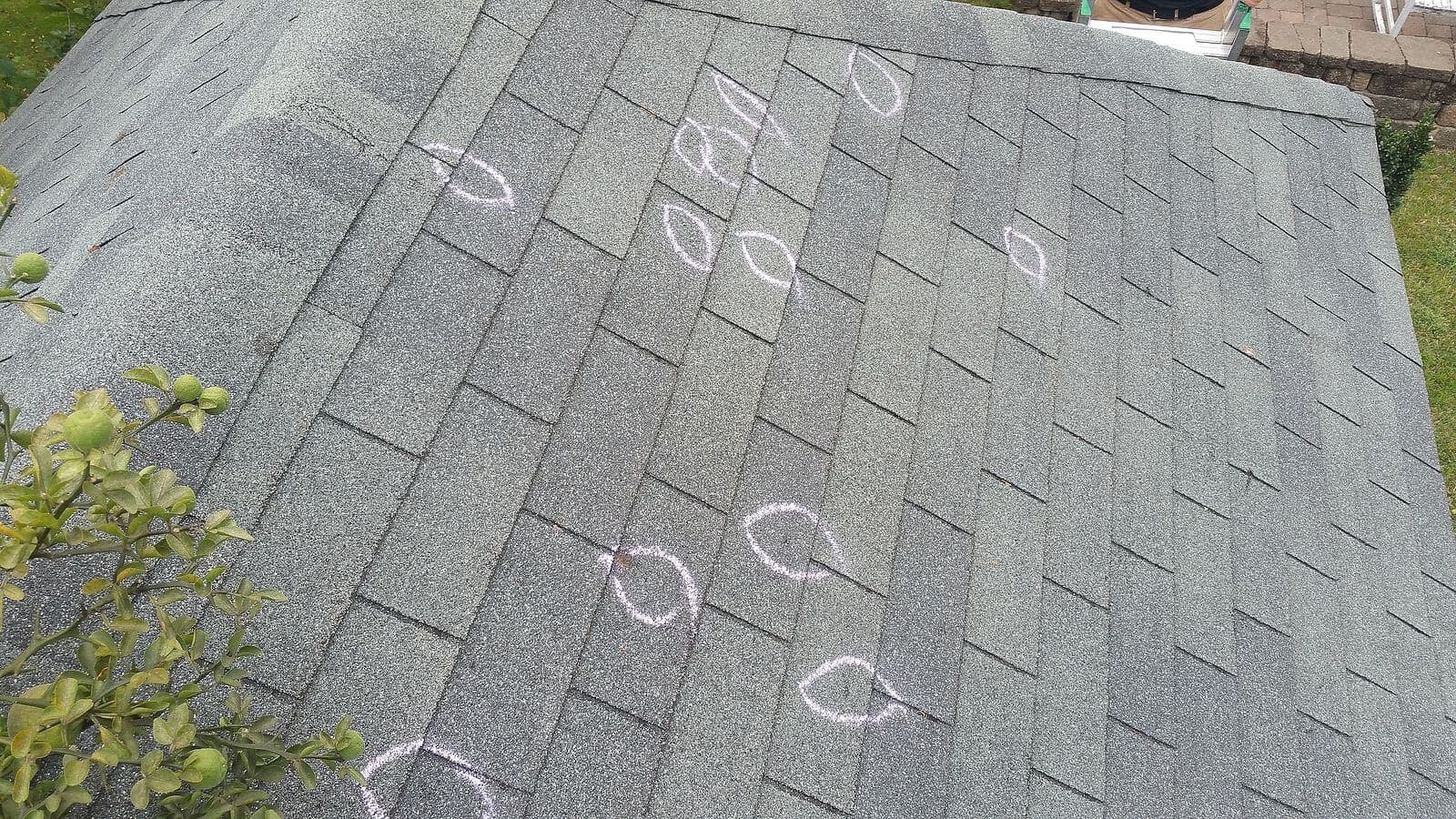
A storm inspection should establish what happened at the property, what physical conditions are present, how they are distributed, and whether those conditions are consistent with the reported hail, wind, or debris event. No single weather report, dent, dark spot, or close-up photograph answers all four questions. The conclusion should follow from the pattern across the site and be understandable to someone who was not there.
The same visit also needs to capture the components and quantities required for a repair scope. Use the Roof Inspection Checklist for Property Claims for that field record. This guide focuses on storm attribution and damage assessment.
Establish the reported event
Record the property address, reported date and approximate time of loss, reported cause, and the source of that information. Note what the occupant or property manager saw, when leaks or other changes were first noticed, and whether photographs or video were taken during or shortly after the event. Ask about earlier leaks, repairs, claims, and storm damage, and identify the source of any roof-age information.
Then review available weather information. Sources may include National Weather Service warnings and local storm reports, the NOAA/NCEI Storm Events Database and Severe Weather Data Inventory, radar-derived products, and qualified forensic-weather services. Preserve the location, time, data type, and limitations of each result. NOAA warns that its severe-weather inventory is incomplete and that radar-derived entries may represent probable rather than confirmed conditions. A nearby report supports context; it does not establish what struck a particular roof. The absence of a database entry does not establish that severe weather missed the property.
The National Weather Service's severe-thunderstorm criteria include hail at least one inch in diameter or wind gusts of at least 58 mph. Those are warning thresholds, not roof-damage thresholds. A roof may be affected below them or remain undamaged above them.
Published testing can help frame the investigation. Haag reports approximate threshold sizes of one inch for lightweight or three-tab asphalt shingles, 1¼ inches for heavyweight or laminated asphalt shingles and wood shingles, and 1½ inches for wood shakes in good condition. Haag's published table also lists 1½ inches for clay tile and 1¾ inches for concrete tile. These are attributed research reference points, not automatic field conclusions. Product, age, support, hail hardness, velocity, and impact angle all affect the result. Compare the weather context with the physical evidence at the site.
Inspect safely and establish a baseline
Do not walk a roof that cannot be accessed safely. Evaluate weather, pitch, height, edge exposure, footing, fragile coverings, skylights, debris, electrical hazards, visible instability, ladder setup, and required fall protection. If direct access is inappropriate, use safe alternatives and state what those methods could not resolve. Follow the detailed safety and limitations prompts in the roof inspection checklist.
Before examining individual marks, document the roof as a system. Assign each plane a direction and identifier. Record the covering, pitch, approximate age and source, visible layers, prior repairs, replaced sections, general weathering, and installation conditions such as high fasteners, exposed fasteners, or poor sealing. Photograph every major plane, including planes where no storm-related condition is found. Include porches, additions, dormers, and detached structures rather than folding them into the nearest main slope.
Complete the scope inventory during the same visit: covering type and exposure; starter and drip edge; ridge and valley construction; vents, penetrations, flashings, and accessories by type and count; intended detach-and-reset or remove-and-replace actions; affected trades; measurements; and emergency work. These details are not proof of storm damage. They are what allows the findings to become an estimate without a second inspection.
Start with the perimeter and interior
Walk the exterior before going to the roof. Photograph an identifying view, each elevation, the visible roof geometry, trees and large debris, roofing material on the ground, temporary repairs, and affected exterior components.
For hail, examine gutters, downspouts, metal fascia and drip edge, roof vents and flashing, window screens and frames, air-conditioner fins, utility boxes, siding and trim, painted or oxidized surfaces, fences, decks, and skylights. Record the component and elevation for both positive and negative observations. A dented gutter may support that hail reached the property; it does not prove that the roof covering was damaged. Do not equate the diameter of a dent or spatter mark with hailstone diameter. Material behavior, impact angle, and hail hardness affect the mark, and long-lived components may carry evidence from an earlier storm.
For wind and debris, note fallen or detached roof material, tree contact, broken glazing, bent gutters or fascia, displaced equipment, and any directional pattern. Compare the exterior pattern with the roof planes later; do not assume they must match.
Where safely accessible, inspect the attic and affected interior. Record active water, stains, water tracks, daylight, wet insulation, displaced or damaged decking, sagging, and moisture near penetrations. For a moisture reading, identify the instrument, location, and value. A stain may predate the reported event, and water can travel before becoming visible, so correlate it with the roof layout rather than assigning a date or entry point from appearance alone. If the interior was not inspected, say so.
Evaluate hail effects by roof material
Hail does not produce one universal damage signature. Identify the material first, then document the physical condition, its distribution, and reasonable alternatives.
Asphalt shingles
IBHS describes three hail-impact modes for asphalt shingles: denting, breach or tearing, and granule displacement. Haag's published protocol uses a narrower damage definition: a bruise or puncture of the reinforcing mat, or granule displacement sufficient to expose underlying bitumen. A bruise is a fracture in the mat that may be felt as a soft spot and is commonly accompanied by granule loss.
Inspect supported shingle fields and more vulnerable locations at ridges, valleys, edges, and just above the headlap. Haag's protocol examines those poorly supported locations before the test areas, because hail capable of fracturing well-supported field shingles should also have fractured some of the shingles that were easiest to damage. Field marks on a roof whose ridges and valleys show no hail effects warrant closer scrutiny. Record the exact condition at each mark; do not substitute “hail hit” for the observation.
Granule loss requires context. Shingles have surplus granules that shed with age and weather, while foot traffic, blistering, manufacturing variation, fastener problems, vegetation, and mechanical contact can also expose asphalt. Hail can displace granules as well. Recently exposed bitumen is black and oxidizes toward gray, which may help with timing but cannot date a mark by itself. Document the shape, edges, distribution, surface below the missing granules, nearby roof condition, and collateral pattern, and state the criterion used. An area of exposed asphalt does not establish its cause by itself.
Metal, tile, and slate
On metal roofing, map dents separately from punctures, tears, open or displaced seams, attachment movement, flashing damage, observable coating disruption, and water entry. IBHS reports no current evidence that denting alone impairs the function of metal roof covering. Whether denting is covered may turn on cosmetic-damage language; a claimed seam, coating, or attachment failure needs its own evidence.
On clay or concrete tile and slate, look for cracked, shattered, chipped, missing, or displaced units; impact locations; fastener-area damage; and fresh versus weathered fracture surfaces. Foot traffic and earlier mechanical damage can create similar breaks, and walking the roof may create new ones. Use suitable access methods and record traffic routes and limitations.
Wood shingles and shakes
Haag's protocol defines hail damage to wood as an impact-caused split or puncture. A hail split coincides with an impact mark and initially has sharp edges and a bright, unweathered fracture through its depth. A weathering split generally follows the grain, has gray and rounded interior surfaces, often tapers toward the head, and may no longer fit together because the wood has shrunk. Flat-grain units weather-split more often than edge-grain units. A recent footfall split can also be bright and sharp but lacks a coincident impact mark.
Haag reports that impact marks which did not split the wood at the time of impact did not later develop into splits in its long-term weathering work. Condition matters: eroded, rotted, cupped, or curled units may split under smaller hail than sound material. Fresh cedar surfaces weather toward gray—often within about six to twelve months—so color can help with timing but should not be used alone.
Low-slope and single-ply systems
Inspect for membrane fractures, punctures, surface damage, distress over insulation joints or gaps, effects at stress plates and other hard points, flashing and equipment damage, and dented or crushed insulation beneath an intact-looking surface. Some fractures are tight and may become more visible only with weathering. If visual inspection cannot establish the condition, identify the need for moisture analysis, sampling, laboratory review, or another specialist rather than guessing.
Inspect separately for wind and debris
Hail, wind, and flying debris may occur in the same event, but they leave different evidence. For asphalt shingles, document displacement, creasing or folding, tearing, fastener pull-through, and complete removal. Record punctures, gouges, and impact marks from debris separately. Pay particular attention to edges, corners, ridges, and rakes, while still inspecting every direction and comparing the distribution with the reported wind and site evidence.
An unsealed shingle is not automatically wind damaged. Self-seal strips can fail to activate after installation or lose bond with age, and tabs may become liftable without a particular storm having displaced or creased them. Thermal movement can also produce patterned partial detachment sometimes called zippering. Record the bond condition, any physical deformation or tear, the pattern across the roof, affected directions, installation details, and the event evidence. “Tab could be lifted by hand on the inspection date” is more precise than “wind-lifted shingle” when no storm-related displacement has been established.
Use hail test areas appropriately
Haag's published protocol uses a 100-square-foot test area to sample conditions on steep-slope roofing. The method calls for test areas on directional slopes, in representative locations away from shelter and heavy traffic. It adds areas when the covering type or age changes and, on large slopes, for each 50 squares of slope area. Poorly supported shingles at ridges, valleys, and edges are evaluated separately.
For each test area:
- Record the plane, dimensions, and location; mark the boundary and take a pre-marking photograph.
- Inspect systematically using the stated visual and tactile criteria.
- Mark and photograph each qualifying condition. Haag's published convention uses an X and circle for hail, F for foot traffic, and W for weathering.
- Record the count by condition type and photograph the entire area after marking, including a zero-count area.
- Identify each party's chalk color during a joint inspection.
This method quantifies findings per roofing square; it is not a universal policy or replacement threshold. There is no generally applicable “8-hit” or “10-hit” rule. In the Haag/NRCA protocol, counts feed a repair-versus-replacement calculation that also considers unit repair cost, a repair-difficulty factor, and slope area. Product availability, matching, repairability, and the applicable estimating or adjusting method may also affect the scope. Preserve the count and criterion before stating the scope conclusion.
Distinguish storm damage from look-alike conditions
A roof can have storm damage and unrelated deterioration at the same time. Compare suspected storm effects with plausible alternatives rather than forcing every condition into one category.
| Condition | Evidence to evaluate |
|---|---|
| Foot traffic or mechanical marring | Traffic routes, scuff or linear shapes, and material pushed up at a mark's perimeter rather than a random impact pattern |
| Blistering | Steep-sided pits, intact blisters nearby, and distribution unrelated to storm direction |
| Manufacturing or bundle variation | Thin or bare areas in columns, diagonals, or repeating installation patterns |
| Ordinary weathering | Roof-wide granule loss, cracking, gray exposed material, curling, or other age-related conditions |
| Installation or fastener conditions | Repeating defects tied to nail placement, attachment, sealing, or a construction detail |
| Prior storm effects | Weathered fractures or exposed material, oxidized dents, earlier repairs, or affected components older than the roof |
| Simulated or mechanical impacts | Unusually uniform size and shape, crushed surfacing, clustered placement, or a pattern inconsistent with the site evidence |
No single feature is conclusive in every case. Photograph the alternative condition and explain which observations support the classification.
Build a reviewable inspection record
Use photographs at four levels: orientation, context, detail, and scale. Add extent views when distribution matters. Photograph unaffected slopes and zero-count test areas as well as the strongest examples. Use consistent plane identifiers in the frame and the file name, retain original images, and keep a photo log. When several parties mark the roof, record which color belongs to each.
The written assessment should include:
- Reported event and its source
- Weather context with location, timing, and limitations
- Inspection methods, access, and areas not inspected
- Roof system, baseline condition, prior repairs, and installation conditions
- Perimeter, collateral, attic, and interior observations
- Hail findings by material and plane
- Wind and debris findings by type and direction
- Test-area location, size, criteria, condition counts, and photographs
- Scope inventory and measurements, or a reference to the completed roof checklist
- Other conditions and reasonable alternatives
- Joint-inspection attendance, access, markings, agreements, disputes, and deferred items
- Conclusions, unresolved questions, and recommended further investigation
Separate reported, observed, measured, and inferred information. “Three shingles on the west slope were torn and displaced” is an observation. “The random mat fractures and contemporaneous collateral effects are consistent with hail impact” is an opinion tied to identified evidence. “The northeast low-slope section was inaccessible and was not inspected at close range” is a limitation.
Do not turn the physical inspection into a coverage opinion. Coverage depends on the policy and claim facts. Internal routing labels or severity scores may be useful within a firm, but they should not replace measurements, counts, and physical observations in the report.
Final review checklist
Before issuing the assessment, confirm that:
- The reported event and weather sources are accurately described, with their limits
- Every roof plane has an overview and a consistent identifier
- Collateral evidence is located by component and elevation, without being treated as proof of roof damage
- Hail, wind, debris, aging, installation, and mechanical conditions are recorded separately
- Material-specific criteria and the test-area method are identified
- Counts, dimensions, negative findings, and inaccessible areas are included
- Detail photographs can be traced to context and orientation views
- Scope-driving components and quantities are captured in the companion checklist
- Each party's markings, observations, and on-site agreements are attributed accurately
- The conclusion distinguishes observation, opinion, and limitation and stays out of coverage
FAQ
What does hail damage look like on asphalt shingles?
Possible impact modes include denting, tearing or rupture, and granule displacement. Under Haag's protocol, a bruise or puncture of the reinforcing mat, or enough impact-related granule displacement to expose bitumen, may qualify. A dark or bare spot alone does not establish hail damage; its physical characteristics, distribution, roof condition, and collateral evidence matter.
What size hail damages a roof?
There is no single size for every roof. Haag publishes approximate thresholds of one inch for lightweight or three-tab asphalt shingles, 1¼ inches for heavyweight or laminated asphalt shingles and wood shingles, and 1½ inches for wood shakes in good condition. Age, support, product, hail hardness, velocity, and angle can change the result. The NWS one-inch criterion is a warning threshold, not a roof rule.
Does a dented gutter prove the shingles were damaged?
No. It may show that hail reached the property and help establish a directional pattern, but the shingles must be evaluated separately. The gutter may also be older than the roof or carry dents from an earlier event.
Is a 10-by-10 test area an industry standard?
It is a longstanding sampling method published by Haag and presented through the North American Conference on Roofing Technology. It measures conditions per roofing square; it is not an automatic repair, replacement, or coverage rule.
How many hail hits require roof replacement?
There is no universal count. The published Haag/NRCA method uses the count in an economic repair-versus-replacement comparison, together with repair cost, difficulty, and slope area. Material availability, matching, repairability, and the method governing the scope also matter.
Does hail damage always cause an immediate leak?
No. Hail can fracture a shingle mat, split wood, or damage a membrane without producing visible interior water entry at once. Conversely, a surface mark may alter appearance without impairing water shedding. Document the specific physical condition instead of using an active leak as the sole test.
Storm inspections and Frontera
A disciplined inspection produces the evidence needed to prepare, compare, and review a scope. Frontera's Estimating tools include a guided inspection workflow that keeps test-area photographs, roof-plane measurements, material findings, and scope details connected to the estimate. The tools can organize inspection support, identify quantity and pricing differences, and produce consistent estimating outputs. They do not determine whether a mark was caused by hail, wind, or debris, or whether the condition is covered. Those decisions remain with the professionals responsible for the evidence and the policy analysis.
References
- National Oceanic and Atmospheric Administration, Severe Weather Data Inventory
- National Weather Service, Severe Thunderstorm Definition
- Insurance Institute for Business & Home Safety, Natural Weathering and Hazard Exposure
- Insurance Institute for Business & Home Safety, Roof 101
- Haag, Protocol for Assessment of Hail-Damaged Roofing and published paper
- Haag, Hail Damage Assessment
- Scott Morrison, Haag, Hail Damage Thresholds: What Do They Really Mean?
- GAF, Roof Damage from Hail: What to Do Next
- Occupational Safety and Health Administration, 29 CFR 1926.500 and 29 CFR 1926.501
- Frontera, Cosmetic Damage Exclusion Guide
This article is for educational purposes and does not constitute engineering, safety, adjusting, or legal advice. Inspection findings, roofing products, code and regulatory requirements, and policy language vary. Consult qualified professionals regarding a specific roof or claim.